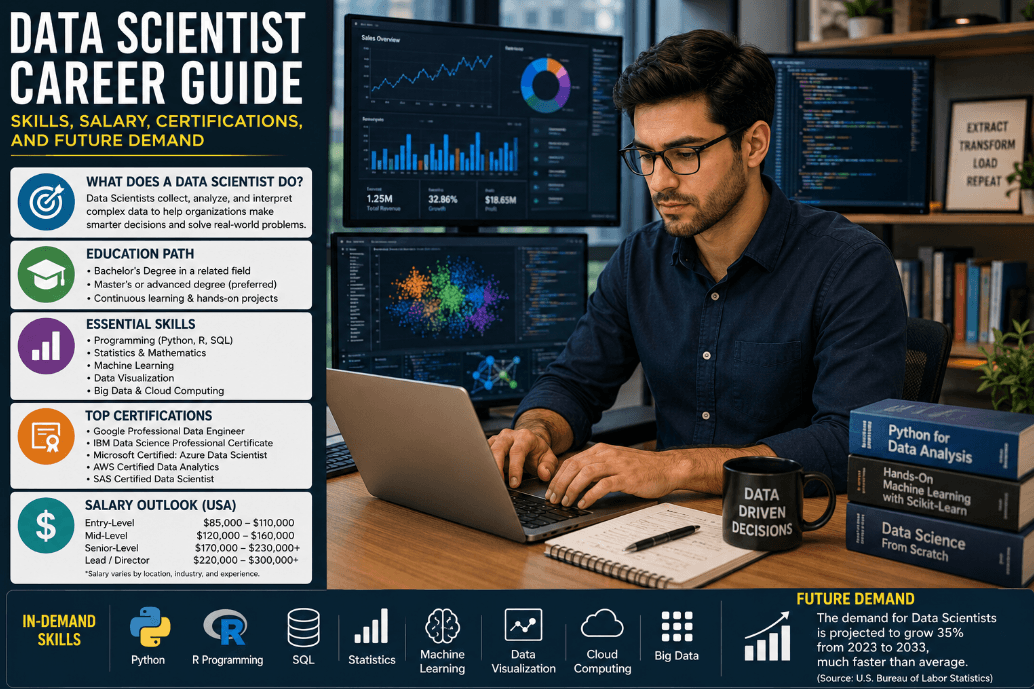
Data has become one of the most valuable assets in the modern economy. Businesses, governments, healthcare organizations, financial institutions, and technology companies rely on data to make informed decisions, identify opportunities, improve efficiency, and gain competitive advantages. As a result, Data Scientists have emerged as some of the most sought-after professionals in the workforce.
Data Scientists transform raw information into meaningful insights that help organizations solve problems and make smarter decisions. They combine expertise in statistics, programming, machine learning, and business analysis to uncover patterns and predict future outcomes.
For individuals who enjoy working with technology, mathematics, and problem-solving, data science offers an exciting and rewarding career path. With strong salaries, growing demand, and opportunities across numerous industries, Data Science remains one of the most attractive career fields in the United States.
What Does a Data Scientist Do?
A Data Scientist collects, analyzes, and interprets large amounts of data to help organizations make strategic decisions. Their goal is to identify trends, build predictive models, and generate actionable insights that support business objectives.
Data Scientists often work closely with executives, analysts, engineers, and business teams to solve complex challenges using data-driven approaches.
Common responsibilities include:
Collecting and organizing data
Cleaning and preparing datasets
Analyzing large data volumes
Building predictive models
Creating machine learning algorithms
Visualizing data insights
Identifying business trends
Developing forecasting models
Supporting decision-making processes
Communicating findings to stakeholders
The role combines technical expertise with business understanding to create measurable value.
Why Demand Is Growing
The demand for Data Scientists continues to increase across virtually every industry.
Several factors are driving this growth:
Rapid digital transformation
Increasing business reliance on data
Advancements in artificial intelligence
Growth of cloud computing
Expansion of e-commerce
Rising demand for predictive analytics
Automation and machine learning adoption
Organizations generate enormous amounts of information every day and need professionals who can turn that data into valuable insights.
As companies become more data-driven, skilled Data Scientists remain highly valuable assets.
Education Requirements
Most Data Scientists begin with a strong educational background in analytical and technical disciplines.
Common degree options include:
Data Science
Computer Science
Statistics
Mathematics
Economics
Engineering
Information Technology
Business Analytics
Employers typically value candidates with strong quantitative skills and technical expertise.
Some professionals also pursue graduate degrees in data science, analytics, or related fields to improve career opportunities.
Essential Technical Skills
Successful Data Scientists develop a combination of technical, analytical, and programming skills.
Programming
Programming forms the foundation of modern data science.
Important languages include:
Python
R
SQL
Java
Scala
Python remains the most widely used language due to its extensive data science ecosystem.
Statistics and Mathematics
Data Science relies heavily on statistical analysis and mathematical modeling.
Professionals should understand:
Probability
Statistical testing
Regression analysis
Linear algebra
Data modeling
Predictive analytics
Machine Learning
Machine learning helps systems identify patterns and make predictions.
Data Scientists frequently use machine learning techniques to solve business problems.
Data Visualization
Presenting information clearly is an important part of the job.
Professionals often use dashboards, charts, and visual reports to communicate findings.
Database Management
Data Scientists work extensively with databases and data warehouses.
Understanding data storage and retrieval processes is essential.
Cloud Computing
Many organizations use cloud-based platforms to store and process large datasets.
Cloud skills continue becoming increasingly valuable.
Important Soft Skills
Technical expertise alone does not guarantee success.
Strong soft skills help Data Scientists communicate insights effectively.
Important qualities include:
Critical thinking
Problem-solving
Communication
Business awareness
Creativity
Collaboration
Adaptability
Presentation skills
Data Scientists often translate complex technical findings into recommendations that business leaders can understand and implement.
Best Certifications for Career Growth
Professional certifications can strengthen resumes and validate technical expertise.
Google Professional Data Engineer
Focuses on designing and managing data solutions within cloud environments.
IBM Data Science Professional Certificate
Provides foundational and advanced data science skills.
Microsoft Certified: Azure Data Scientist Associate
Demonstrates expertise in machine learning and cloud-based analytics.
SAS Certified Data Scientist
Recognized certification for advanced analytics and predictive modeling.
AWS Certified Data Analytics
Focuses on data analysis solutions within cloud platforms.
Certifications can be particularly valuable for career changers and early-career professionals.
A Typical Day as a Data Scientist
The daily work of a Data Scientist varies based on industry and project requirements.
A typical day may include:
Reviewing business objectives
Gathering datasets
Cleaning and organizing data
Building predictive models
Testing machine learning algorithms
Creating visual reports
Meeting with stakeholders
Presenting findings
Improving model performance
Researching new analytical techniques
The work often combines technical problem-solving with strategic business analysis.
Step-by-Step Career Roadmap
Step 1: Build Mathematical Foundations
Develop strong knowledge of mathematics, statistics, and probability.
These subjects support advanced data analysis and machine learning.
Step 2: Learn Programming
Master programming languages commonly used in data science.
Python and SQL are excellent starting points.
Step 3: Study Data Analysis
Learn how to collect, clean, organize, and analyze datasets.
Develop experience using analytical tools and software.
Step 4: Learn Machine Learning
Study predictive modeling, algorithm development, and machine learning fundamentals.
Step 5: Create Practical Projects
Hands-on projects demonstrate technical abilities to employers.
Examples include:
Sales forecasting models
Customer behavior analysis
Recommendation systems
Predictive healthcare applications
Fraud detection models
Step 6: Earn Certifications
Industry certifications can improve credibility and employability.
Step 7: Secure an Entry-Level Position
Common starting roles include:
Data Analyst
Business Analyst
Junior Data Scientist
Research Analyst
Machine Learning Associate
Step 8: Specialize
Experienced professionals often focus on:
Artificial Intelligence
Machine Learning
Business Intelligence
Healthcare Analytics
Financial Analytics
Marketing Analytics
Specialization frequently leads to higher salaries and advanced career opportunities.
Salary Expectations in the United States
Data Science remains one of the highest-paying career fields.
Typical salary ranges include:
Entry-Level Data Scientist: $85,000–$110,000
Mid-Level Data Scientist: $120,000–$160,000
Senior Data Scientist: $170,000–$230,000+
Lead Data Scientist: $220,000–$300,000+
Chief Data Officer: $300,000+
Compensation varies based on location, industry, technical expertise, and professional experience.
Professionals working in technology, finance, and artificial intelligence often earn the highest salaries.
Industries Hiring Data Scientists
Data Scientists work across a wide variety of industries.
Technology
Technology companies rely heavily on data for product development and strategic decisions.
Healthcare
Healthcare organizations use analytics to improve patient outcomes and operational efficiency.
Finance
Financial institutions apply data science to fraud detection, risk analysis, and investment management.
Retail and E-Commerce
Retailers use data to understand customer behavior and optimize sales strategies.
Insurance
Insurance companies analyze risk and customer trends using advanced analytics.
Manufacturing
Manufacturers apply predictive analytics to improve operations and reduce downtime.
Government
Government agencies increasingly use data science for policy analysis and public service improvements.
Data Scientist vs Data Analyst
These careers share similarities but have important differences.
Data Analysts primarily focus on examining historical data and generating reports.
Data Scientists typically build predictive models, develop machine learning solutions, and solve more complex analytical problems.
Data Science often requires deeper technical expertise and advanced analytical skills.
Common Mistakes Beginners Make
Focusing Only on Tools
Understanding analytical concepts is more important than memorizing software features.
Ignoring Business Knowledge
Technical skills become more valuable when combined with business understanding.
Avoiding Real Projects
Practical experience is essential for building credibility and confidence.
Weak Communication Skills
Data Scientists must explain insights clearly to non-technical audiences.
Chasing Every New Trend
Mastering fundamentals provides a stronger foundation for long-term success.
Advantages of This Career
Data Science offers numerous professional benefits.
High earning potential
Strong job demand
Career flexibility
Remote work opportunities
Continuous learning
Innovation-driven environment
Global career opportunities
Long-term growth potential
These advantages continue attracting professionals from diverse educational backgrounds.
Challenges to Consider
The profession also presents challenges.
Complex technical problems
Continuous learning requirements
Large datasets
Rapid technological change
High expectations
Data quality issues
Many professionals find these challenges rewarding because they encourage ongoing growth and innovation.
Future Outlook and Job Growth
The future outlook for Data Scientists remains exceptionally strong.
Organizations continue investing heavily in analytics, machine learning, and artificial intelligence technologies. Businesses increasingly depend on data-driven decision-making to remain competitive.
As data volumes continue growing, demand for professionals who can transform information into strategic insights is expected to remain high.
Data Science is likely to remain one of the most influential and valuable career fields throughout the coming decade.
How to Get Started
Aspiring Data Scientists should begin by developing strong foundations in mathematics, statistics, and programming.
Learn Python and SQL.
Study data analysis techniques.
Build practical projects.
Explore machine learning concepts.
Earn relevant certifications.
Create a professional portfolio.
Stay current with industry developments.
Consistent learning and hands-on experience are often the fastest paths to success.
Conclusion
Data Scientists help organizations transform raw information into valuable business insights. Their expertise supports decision-making, innovation, and competitive advantage across virtually every industry.
For individuals interested in technology, analytics, and problem-solving, Data Science offers excellent earning potential, strong job demand, and exciting career opportunities. As organizations continue embracing data-driven strategies, Data Scientists will remain among the most valuable professionals in the modern workforce.
FAQs
Is Data Science a good career in 2026?
Yes. Data Science remains one of the fastest-growing and highest-paying career fields.
Do Data Scientists need a degree?
A degree is helpful, but employers increasingly value technical skills, certifications, and practical experience.
Can Data Scientists earn six-figure salaries?
Yes. Many Data Scientists earn six-figure incomes, particularly as they gain experience and specialization.
What programming language is most important for Data Science?
Python is currently the most widely used programming language in the field.
Is Data Science difficult to learn?
It can be challenging, but individuals who enjoy mathematics, programming, and problem-solving often find the learning process rewarding.







Be First to Comment