Insurance companies play a critical role in helping individuals and businesses recover from unexpected losses. Whether the damage results from a car accident, natural disaster, property loss, or workplace incident, Claims Adjusters are the professionals responsible for investigating claims and determining appropriate compensation.
Claims Adjusters serve as a vital link between policyholders and insurance companies. They assess damages, review insurance policies, gather evidence, interview involved parties, and recommend settlements based on their findings. Their work helps ensure that claims are handled fairly, efficiently, and according to policy guidelines.
As the insurance industry continues evolving, Claims Adjusters remain in demand across multiple sectors. For individuals interested in investigation, problem-solving, customer interaction, and insurance operations, this career offers strong earning potential, career stability, and opportunities for advancement.
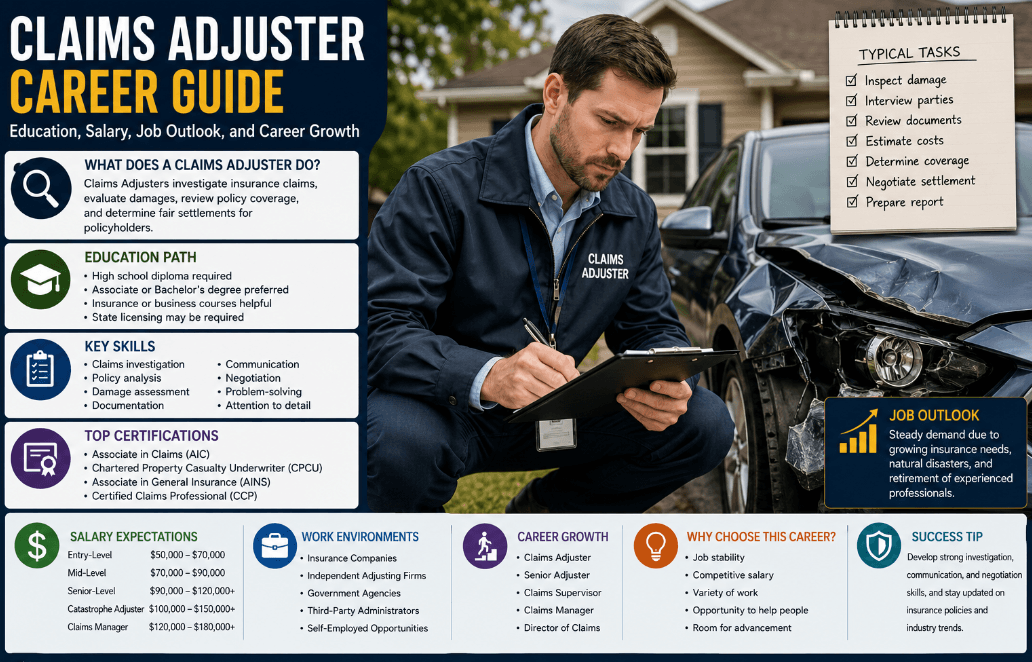
What Does a Claims Adjuster Do?
A Claims Adjuster investigates insurance claims to determine the extent of an insurer’s liability.
Their primary responsibility is to evaluate claims and ensure that policyholders receive appropriate compensation based on policy terms and coverage limits.
Common responsibilities include:
Investigating insurance claims
Inspecting property damage
Interviewing claimants and witnesses
Reviewing insurance policies
Analyzing documentation
Estimating repair costs
Determining claim validity
Negotiating settlements
Preparing claim reports
Communicating with policyholders
Claims Adjusters often work on automobile, property, health, commercial, and liability insurance claims.
Why Demand Is Growing
The insurance industry continues experiencing steady demand for claims professionals.
Several factors contribute to ongoing opportunities:
Natural disasters and weather-related claims
Growing property values
Increasing vehicle ownership
Expansion of commercial insurance markets
Rising insurance coverage adoption
Retirement of experienced insurance professionals
Growth in specialty insurance products
Although technology has automated some processes, many claims require human judgment, investigation, and negotiation skills.
Experienced Claims Adjusters remain valuable assets within the insurance sector.
Education Requirements
Most Claims Adjusters enter the profession with a high school diploma, associate degree, or bachelor’s degree.
Common educational backgrounds include:
Business Administration
Finance
Economics
Risk Management
Insurance Studies
Criminal Justice
Public Administration
Communication
Many employers provide on-the-job training for new hires.
Some states may require licensing or specific certifications before professionals can handle claims independently.
Essential Technical Skills
Successful Claims Adjusters develop a variety of technical competencies.
Claims Investigation
The ability to gather information and evaluate evidence is essential.
Policy Analysis
Adjusters must understand policy language, coverage limits, exclusions, and legal requirements.
Damage Assessment
Property and vehicle claims often require estimating repair costs and evaluating losses.
Documentation Management
Accurate records support claim decisions and regulatory compliance.
Insurance Software
Modern claims operations rely on digital platforms and claims management systems.
Regulatory Knowledge
Insurance laws and regulations vary by state and industry.
Claims professionals must stay informed about applicable requirements.
Important Soft Skills
Strong interpersonal skills are critical for success in this profession.
Important soft skills include:
Communication
Negotiation
Empathy
Problem-solving
Attention to detail
Decision-making
Conflict resolution
Time management
Claims Adjusters frequently work with individuals experiencing stressful situations, making professionalism and compassion important qualities.
Best Certifications for Career Growth
Professional certifications can improve expertise and advancement opportunities.
Associate in Claims (AIC)
One of the most respected credentials for claims professionals.
It focuses on claims handling, investigation, and insurance principles.
Chartered Property Casualty Underwriter (CPCU)
A highly respected designation covering risk management and insurance operations.
Associate in General Insurance (AINS)
Provides broad insurance industry knowledge.
Certified Claims Professional (CCP)
Focuses on advanced claims management and professional development.
Certifications demonstrate commitment to excellence and can increase earning potential.
A Typical Day as a Claims Adjuster
Daily responsibilities vary depending on claim type and employer.
A typical day may include:
Reviewing new claims
Contacting policyholders
Inspecting damaged property
Photographing evidence
Interviewing witnesses
Analyzing documentation
Estimating losses
Negotiating settlements
Updating claim records
Communicating claim decisions
Some adjusters spend significant time in the field, while others primarily work in office or remote environments.
Step-by-Step Career Roadmap
Step 1: Complete Basic Education
Earn a high school diploma or pursue higher education in business, insurance, or related fields.
Step 2: Learn Insurance Fundamentals
Develop knowledge of insurance policies, claims procedures, and industry terminology.
Step 3: Obtain Required Licensing
Complete state-specific licensing requirements if applicable.
Step 4: Gain Entry-Level Experience
Many professionals begin as:
Claims Assistant
Claims Representative
Customer Service Specialist
Insurance Processor
Administrative Claims Coordinator
Step 5: Become a Claims Adjuster
Transition into full claims investigation and settlement responsibilities.
Step 6: Earn Professional Certifications
Industry credentials can support advancement and specialization.
Step 7: Advance into Leadership Roles
Career progression may include:
Senior Claims Adjuster
Claims Supervisor
Claims Manager
Risk Consultant
Insurance Operations Director
Salary Expectations in the United States
Claims Adjusters earn competitive salaries that increase with experience and specialization.
Typical salary ranges include:
Entry-Level Claims Adjuster: $50,000–$70,000
Mid-Level Claims Adjuster: $70,000–$90,000
Senior Claims Adjuster: $90,000–$120,000+
Catastrophe Claims Adjuster: $100,000–$150,000+
Claims Manager: $120,000–$180,000+
Income can vary based on geographic location, employer, certifications, and claim specialization.
Industries Hiring Claims Adjusters
Claims professionals work across multiple industries.
Property and Casualty Insurance
This sector handles home, business, and vehicle-related claims.
Health Insurance
Health insurers employ claims specialists to review medical claims and coverage requests.
Workers’ Compensation
Claims professionals manage workplace injury cases and benefit determinations.
Commercial Insurance
Businesses require specialized claims expertise for complex losses.
Government Agencies
Public sector organizations occasionally employ claims professionals for risk and insurance functions.
Third-Party Claims Administrators
Many organizations outsource claims management to specialized service providers.
Claims Adjuster vs Insurance Underwriter
These careers often work closely together but have different responsibilities.
Insurance Underwriters evaluate risks before policies are issued.
Claims Adjusters investigate losses after claims are submitted.
Underwriters focus on risk selection, while adjusters focus on claim resolution and settlement.
Both careers play essential roles within the insurance industry.
Common Mistakes Beginners Make
Failing to Understand Policy Language
Coverage decisions depend heavily on policy details.
Poor Documentation Practices
Accurate records are critical for claim management.
Weak Communication Skills
Clear communication helps resolve claims more effectively.
Rushing Investigations
Thorough investigations improve decision quality.
Avoiding Continuing Education
Insurance regulations and industry standards evolve regularly.
Advantages of This Career
Claims adjusting offers several attractive benefits.
Strong job stability
Competitive salaries
Career advancement opportunities
Variety of work environments
Opportunities for remote work
Transferable business skills
Professional development options
Industry diversity
These advantages make the profession appealing to individuals with analytical and interpersonal strengths.
Challenges to Consider
The role also presents challenges.
Handling difficult situations
Managing large claim volumes
Meeting deadlines
Complex investigations
Negotiation pressures
Emotional interactions with claimants
Many professionals find the work rewarding because they help people recover from significant losses.
Future Outlook and Job Growth
The future remains positive for Claims Adjusters.
Insurance companies continue requiring professionals who can investigate claims, assess damages, and negotiate settlements fairly.
Emerging areas such as cybersecurity insurance, climate-related risks, and specialized commercial coverage are creating new opportunities for claims professionals.
Adjusters who combine industry knowledge, technology skills, and strong communication abilities will remain highly valuable.
How to Get Started
Individuals interested in claims careers should begin by learning insurance fundamentals.
Research licensing requirements.
Develop communication skills.
Gain customer service experience.
Explore entry-level insurance positions.
Pursue professional certifications.
Build industry knowledge.
Develop investigative and analytical abilities.
Consistent learning and practical experience can lead to long-term success in the insurance industry.
Conclusion
Claims Adjusters play an important role in helping policyholders recover from unexpected losses while ensuring that insurance claims are handled fairly and accurately. Their ability to investigate situations, evaluate evidence, and negotiate settlements makes them essential professionals within the insurance industry.
For individuals interested in insurance, investigation, customer service, and problem-solving, claims adjusting offers a stable and rewarding career with strong earning potential and advancement opportunities. As insurance markets continue evolving, skilled Claims Adjusters will remain valuable contributors across the industry.
FAQs
Is Claims Adjusting a good career?
Yes. Claims adjusting offers job stability, competitive salaries, and opportunities for advancement within the insurance industry.
Do Claims Adjusters need a college degree?
Not always. Many employers accept candidates with relevant experience, training, or associate degrees, although bachelor’s degrees can improve opportunities.
Can Claims Adjusters work remotely?
Yes. Many insurance companies offer remote and hybrid claims positions.
What certification is best for Claims Adjusters?
The Associate in Claims (AIC) designation is one of the most respected certifications in the field.
Can Claims Adjusters earn six-figure salaries?
Yes. Senior adjusters, catastrophe specialists, and claims managers often earn six-figure incomes.






Be First to Comment